Different Types Of Surface Treatment Process For Aluminum Profiles
POSTED ON JULY 18, 2022 BY PAILIAN ALUMINUM
It is well-known that aluminum is versatile and relatively inexpensive as its high strength-weight ratio and corrosion resistance. Furthermore, aluminum is environmentally friendly enough to accept high performance coatings.
As there are different types of surface treatment for aluminum profiles, one of the most important decision you need to decide is to choose which surface treatment after deciding to design custom aluminum profiles.
Two main reasons for choosing surface treatment:
Firstly, surface treatment can improve corrosion resistance.
Aluminum has a natural oxide film that protects it from corrosion which is sufficient for many applications. But in some settings, additional protection may be needed.
Secondly, surface treatment can enhance the appearance of aluminum.
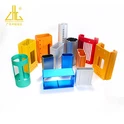
Depending on what you want to achieve, you'll need to choose the right finish. Maybe you want something brightly colored or achieve a "mirror" effect. You need to choose a finish that will give you the look you want.
Here are seven different types of surface treatments for aluminum profiles:
1. Mechanical finishing
Aluminum can be polished, sandblasted, brushed, ground or sanded. These finishes can improve surface quality or prepare for other surface treatments.
2. Pretreatment
Aluminum can be etched or cleaned with alkaline or acidic materials and then added a pretreatment coating so that to enhance the adhesion of powder or paint to provide resistance to corrosion.
3. Bright dipping
The extruded parts can be brightly impregnated to give the aluminum a mirror effect. As a result, technicians place profiles into the special leaches called mixture of hot phosphoric and nitric acid. After bright impregnation, the profiles can also be anodized to thicken the corrosion resistant oxide layer of the metal.
4. Anodic oxidation
In addition to the natural oxide film, anodic oxidation provides additional protection. A durable porous anodic oxide layer is formed on the aluminum surface. Furthermore, anodized alumina not only can accept bright colorsbut also improves its surface hardness and wear resistance.
5. Spray paint
Spray paint is the use of compressed air to disperse liquid paint (commonly known as paint) which usually contains volatile organic compounds (VOCs) into paint mist particles adhere to the surface of the profile with a variety of colors and liquid paint will remove during curing or baking. A large number of solids form films on the profiles when the volatile organic compounds disappear.
6. Powder coating
Powder spraying is to use powder spraying equipment (electrostatic spray molding machine) to spray the powder coating to the surface of the product, under the electrostatic action, the powder will be evenly adsorbed on the surface of the product, forming a powdery coating; The powdery coating is baked at high temperature, leveled and cured, and becomes a coating with different effects (different kinds of effects of powder coating). At the same time, powder spraying does not contain volatile organic compounds.
7. Thermal transfer
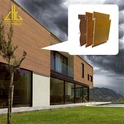
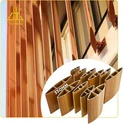
Have you ever seen extruded aluminum that looks like wood? Profiles can be heat transferred after being coated with a powder base coating. Technicians wrap the profiles in a patterned film. The heat transfer process transfers the pattern directly to the extruded profile.
Summary
Whether you're designing a new building or the interior of a train car, aluminum profiles are an important part of your project. Choosing the right finish will ensure that your extruded profile has the right appearance and proper corrosion resistance.