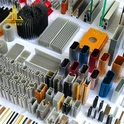
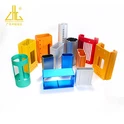
Nowadays, aluminum profiles have a wide application in every field of construction, home decoration, and decoration because of their low density, lightweight, machinability, and plasticity. Since 2006, China has surpassed the United States to become the world's largest producer and seller of aluminum extrusions. According to statistics on the official website of the China Non-Ferrous Metal Industry Association, the global output of electrolytic aluminum in 2017 was about 63 million tons, while China's capacity of aluminum profiles reached 19.5 million tons. Aluminum profiles account for about 70%. Although the aluminum profile can form the dense Al2O3 oxide film in the air and has good self-healing properties, the oxide film is too thin, and the protection of the aluminum profile is limited, which affects the service life and appearance of the profile.
Therefore, it is necessary to do some surface protection treatments on aluminum profiles. On the one hand, they can improve the wear and corrosion resistance to extend the aluminum profiles' service life. On the other hand, they can improve the few surface defects caused by aluminum profiles during machining and provide a variety of rich surface decoration effects, improving the profile appearance.

So far, anodic oxidation, electrophoretic coating, and powder coating are the chief surface treatment methods on aluminum profiles. Each of these three methods has advantages and occupies a considerable market share. Anodic oxidation is a method of forming an oxide film on the surface of an aluminum profile by the electrolytic oxidation principle. The oxide film prepared by this method has high wear resistance, good heat insulation, and corrosion resistance, which can meet the requirements of use in a continental climate environment. Typical sulfuric acid anodizing processes include mechanical pretreatment, chemical pretreatment, anodizing, coloring, and sealing. The electrophoretic coating process is the same as the anodic oxidation process. Powder coating is a coating method that uses the corona discharge principle to make atomized coating become negatively charged under the action of a high voltage direct current electric field and then adsorbed on the surface of the positively charged substrate for discharge.

Generally, aluminum profiles will pretreat before spraying to improve the adhesion and corrosion resistance of the coating. Compared with anodic oxidation and electrophoresis, there are no distinct advantages in appearance uniformity, weather resistance, and other aspects of powder coating. But it has distinct advantages in wear resistance, acid resistance, flexibility, and decoration. In addition, since the powder spraying process is simple, it has distinct advantages in energy saving and environmental protection. The power consumption per ton of anodic oxidation can reach about 1000 degrees. Anodizing, coloring, and sealing, as well as electrophoresis processes, require the use of large amounts of acids, bases and nickel salts, etc., and the post-treatment pressure of wastewater and exhaust gases is high. The pretreatment of powder coating is mainly degreasing and passivation. Energy consumption is reflected in the curing process of coating, which reduces energy consumption enormously; powder coating does not contain solvent, VOC emission is almost zero, and environmental protection pressure is less. It has become one of the aluminum coating technologies with widespread application prospects.