Aluminum profiles are popular for their durability, strength, and lightweight nature, making them ideal for construction, transportation, and various industrial applications. However, aluminum is a relatively soft metal that can easily succumb to wear and tear, corrosion, and other forms of damage.
To address these issues, manufacturers have developed a surface treatment method known as hard anodization, which enhances the surface hardness and strength of aluminum profiles, making them more resistant to wear and tear and other forms of damage. But what exactly is a hard anodized finish, and what are its benefits for aluminum profiles?

Anodizing is an electrolytic passivation process that involves the formation of a thin layer of anodized aluminum on the outer surface of aluminum profiles. This process improves the durability and appearance of the profile by integrating the anodized layer into the metal structure instead of just applying it to the surface like paint or electroplating. The result is a long-lasting finish that does not chip or flake.
When the acid solution used for anodizing is cooled to the freezing point of water, the current increases significantly and a harder anodized glossy surface can be obtained. This process is called hard anodizing, and it creates a thick oxide film that is characterized by high hardness and is often used for wear resistance, heat resistance, and insulation.
The main purpose of anodizing, whether using a regular or hard anodized process, is to improve the various properties of aluminum and aluminum alloy profiles. These properties include corrosion resistance, wear resistance, weather resistance, insulation, and adsorption. Anodizing is particularly suitable for aluminum extrusion profiles and can also be used for die-casting aluminum alloy parts.

There are several benefits to using a hard anodized finish for aluminum profiles. The most notable of these include:
1. Enhanced surface hardness: By effectively doubling the surface hardness of the aluminum profile, a hard anodized finish ensures that it is much more resistant to abrasion, wear, and other forms of damage. This, in turn, increases its lifespan and reduces the need for frequent replacements or repairs.
2. Increased wear resistance: In addition to being harder, the surface of a hard-anodized aluminum profile is also much more resistant to wear and tear caused by friction, sliding, or impact. This makes it ideal for use in heavy-duty applications that require maximum durability and wear resistance, such as transportation, construction, and industrial machinery.
3. Corrosion resistance: Along with hardness and wear resistance, a hard anodized finish also enhances the corrosion resistance of an aluminum profile. This is particularly important for applications that expose the profile to harsh or corrosive environments, such as marine or chemical processing applications.
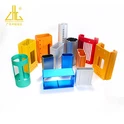
4. Aesthetics: Finally, a hard anodized finish can be customized to achieve a wide range of colors, textures, and surface finishes, making it ideal for use in decorative or aesthetic applications.
In summary, a hard anodized finish is an effective surface treatment method for enhancing the hardness, wear resistance, and corrosion resistance of aluminum profiles. By undergoing this process, aluminum profiles become more durable, long-lasting, and suited for a wide range of industrial and decorative applications.