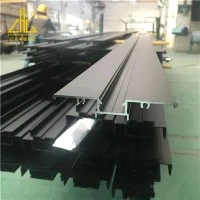
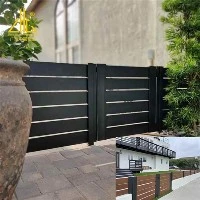
Hey there! As a supplier of large size 350mm aluminum profiles, I often get asked about all sorts of technical details. One question that pops up quite a bit is, "What is the Poisson's ratio of large size 350mm aluminum profiles?" Let's dive into this topic and break it down in a way that's easy to understand.
First off, what the heck is Poisson's ratio? Well, it's a measure of how a material behaves when it's stretched or compressed. When you pull on a material, it not only gets longer in the direction you're pulling, but it also gets thinner in the directions perpendicular to the pull. Poisson's ratio is the ratio of the transverse strain (the change in thickness) to the axial strain (the change in length).
For aluminum, the Poisson's ratio typically falls in the range of about 0.32. This means that when you stretch an aluminum profile, for every unit of length it gains in the direction of the stretch, it'll lose about 0.32 units of thickness in the perpendicular directions. But it's important to note that this is just an average value. The actual Poisson's ratio can vary depending on a few factors.
One of the main factors that can affect the Poisson's ratio of our large size 350mm aluminum profiles is the alloy composition. Different aluminum alloys have different microstructures, which can influence how the material deforms under stress. For example, the 6061 alloy, which is commonly used in our Extruded 6061 Auxiliary Road Aluminum Track Profile, has a slightly different Poisson's ratio compared to other alloys. The 6061 alloy is known for its good strength and corrosion resistance, and its Poisson's ratio is pretty close to the average for aluminum, but it might be a bit different due to the specific elements in the alloy.
Another factor is the manufacturing process. The way we extrude our large size 350mm aluminum profiles can also impact the Poisson's ratio. During extrusion, the aluminum is forced through a die to give it the desired shape. This process can cause some internal stresses and changes in the microstructure of the material. If the extrusion process isn't carefully controlled, it could lead to variations in the Poisson's ratio. But don't worry, we've got our extrusion process down to a science, and we make sure to keep a close eye on the quality to ensure consistent properties in our profiles.
Now, you might be wondering why the Poisson's ratio matters. Well, it's actually quite important in engineering applications. When designing structures or components using our large size 350mm aluminum profiles, engineers need to take into account how the material will deform under load. The Poisson's ratio helps them predict how the profile will change shape and size when subjected to different forces. This is crucial for ensuring the structural integrity and performance of the final product.
For example, if you're using our Factory Extruded Black Anodized Aluminum Cabinet Handles in a cabinet design, you need to know how the handles will respond to the forces applied when opening and closing the cabinet. The Poisson's ratio will help you determine if the handles will deform in a way that could affect their functionality or appearance.
In addition to its importance in engineering design, the Poisson's ratio can also give us some insights into the quality of our aluminum profiles. If we measure the Poisson's ratio of our profiles and it falls outside of the expected range, it could indicate a problem with the alloy composition or the manufacturing process. This allows us to take corrective actions and ensure that our products meet the highest standards.
So, to sum it up, the Poisson's ratio of our large size 350mm aluminum profiles is typically around 0.32, but it can vary depending on the alloy composition and the manufacturing process. Understanding this ratio is crucial for engineers and designers who use our profiles in their projects.
If you're in the market for high-quality large size 350mm aluminum profiles, look no further! We're here to provide you with top-notch products that meet your specific needs. Whether you need Extruded 6061 Auxiliary Road Aluminum Track Profile, Factory Extruded Black Anodized Aluminum Cabinet Handles, or Custom Electrophoretic Anodized Aluminum Plate, we've got you covered.


Don't hesitate to reach out to us for more information or to discuss your procurement needs. We're always happy to chat and help you find the perfect aluminum profiles for your project.
References:
- Callister, W. D., & Rethwisch, D. G. (2017). Materials Science and Engineering: An Introduction. Wiley.
- Ashby, M. F., & Jones, D. R. H. (2012). Engineering Materials 1: An Introduction to Properties, Applications and Design. Butterworth-Heinemann.